Book Ad

If you enjoy Liberty Takes Effort posts and pages, please consider my recent books.

Brotherhood and Borders cover

Brotherhood and Borders

A thoughtful look at immigration, compassion, division, and the rule of law in America.

Buy on Amazon
Small-Town Boomers cover

Small-Town Boomers

A nostalgic look back at growing up in Randolph, Massachusetts, and the small-town Boomer experience.

Buy on Amazon

Is our partisan political division biological?

Stephen Stills wrote a song in 1966 for the group Buffalo Springfield titled “For What It’s Worth.”  It became an anti-war protest anthem of sorts in the 1960’s. The song seems more broadly applicable today than in 1966.  Parsing the lyrics:   

There's battle lines bein' drawn.  Nobody's right if everybody's wrong.  A thousand people in the street.  Singin' songs and a-carryin' signs.  Mostly sayin' hooray for our side. 

In the responding chorus, Stills gives good counsel singing, “It’s time we stop children, what’s that sound, everybody look what’s goin’ down.”

Western countries are increasingly divided in partisan political animosity that is personal and intense - the U.S. most acutely.   Mutually antagonistic political groupings cast their political identity like an umbrella over personal and professional relationships.  Irrational allegiance to political identity and confirmation bias are at play, not opinion. Shared opinions on specific issues and policies flourish across the dividing lines.  Many people hold political identities that are largely inconsistent with many of their expressed opinions and policy preferences.    Much is written about the divide - when it started; how it gets worse with time; that it may cause the breakup of the U.S. or even a civil war. 

Both sides of the divide seek to impose their values through control of government, particularly national government, and through cultural and economic entities.   On the one side, the goal is to restore a nostalgic, almost mythical past, and stop change that is often essential to the renewal of institutions and culture.  On the other side, the goal is to transform society to an unattainable political and cultural utopia that necessitates the destruction of the social institutions that bind society and undergird civilization.
Mourning with Uvalde – what can we do?

 After the Parkland murders occurred, and again after the Santa Fe murders I asked my readers to take action.   I ask you again to please take individual action within your own sphere of influence. Please, also communicate with school and governmental leaders. Hold them accountable and demand that they implement solutions. Do not assume that your schools are safe.  Demand testing, practice, and exercise protocols be instituted.

Once again America mourns the loss of innocent children.  How horrible for the people of Uvalde to suffer such a loss of innocent life.  That such things can happen seems unimaginable, but we know them all too well.  May each of these families, and the community of Uvalde, find peace and healing after their immense loss.  May their loss and God’s love inspire our nation to gain the understanding and wisdom needed to come together with humility in a cooperative manner to prevent such horror in other communities.

My House Price is Inflated – Should I Sell?

Average U.S. national house prices have increased to record levels.  Homeowners may view the current market as an excellent opportunity to sell.  While the market is high, there are also indications that a correction may occur within the next few years.  Selling near peak and waiting out a correction to buy at a lower price is a potentially profitable option.  In pursuing such action, it is important to distinguish assumptions from facts in decision-making.

In my last blog post, “Real Estate and the First Time Buyer,” I provided an assessment of how the housing market arrived at its present state and explored possible outcomes in the market in the coming two years.  It was written for the benefit of the first-time buyer.   This post builds upon that analysis and explores options for the high equity owner thinking of selling.

There are many reasons to consider selling in the current market.   For example, one’s financial portfolio may be disproportionately allocated to real estate due to the rise in prices.   Or one might be at the limit of the real estate capital gain tax exclusion ($250,000 single or $500,00 couple).   Selling now would restart the two-year exemption timeline on the next house and save significant taxation.  Maybe there were already plans to downsize or retire or move to another job or make a vacation home or rental property into a permanent residence.

There are too many scenarios to assess in this limited space.   The context of people’s lives and regional housing market conditions vary considerably.  So, the remainder of this post will explore a single case study that can provide broad insight in many scenarios. 

Real Estate and the First Time Buyer

Home ownership is the key to wealth development in the United States.   Record high home prices are distorting the real estate market such that many first-time buyers are unable to buy a home.  A national average housing price correction of 10-20% may be in the offing, but inflation and rising interest rates will more than offset the benefit of lower prices to make housing more unaffordable.   Potential first time buyers will need to be sophisticated, agile, and disciplined to position themselves for opportunities that may arise in what will likely be a volatile market in the next few years.

Home prices are high by nearly all measures, but there is wide regional variation.  The CoreLogic Home Price Index (HPI) posted the highest year-over-year growth in its 44-year history by the end of 2021. CoreLogic last week reported 65 percent of regional U.S. housing markets are overvalued based on earnings to price ratios.   Zillow reported in February, 2022 that 481 cities nationwide have a typical home value of at least $1 million and 49 more may join the list this year.

How Did We Get Here?

Russia's Illegal War Upon Ukraine

 Author Note: I have been on hiatus for several months due to travel and simply being too busy in retirement with other priorities. I still intend to blog but not as frequently.  The war in Ukraine, filled with unspeakable horror and sorrow weighs on many people as they confront video of the suffering of the Ukrainian people.  Some folks have asked for my opinion on the war and its implications. I offer my thoughts here for your consideration.

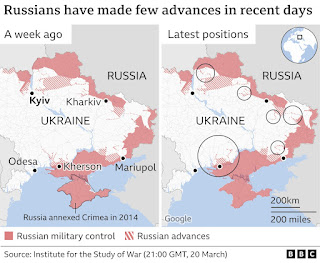
A settlement of the Russia-Ukraine War will likely be agreed in the coming weeks as Russia’s military objectives move further from reach and Western solidarity and support of Ukraine intensify.  In this fourth week of battle the outcome is coming into focus.   Russian President Vladimir Putin’s original plan to quickly take control of the Ukrainian capital at Kyiv, install a puppet government, and establish a compliant Belarus-type satellite state failed.  It appears Russia is now preparing the groundwork for a best possible negotiated outcome, though Putin will likely continue to take escalatory steps to weaken Ukrainian will and intimidate its Western supporters until a final settlement is reached.

Memorial Day – what happened to the parades and walks in cemeteries?

 I vividly recall from my childhood the prominence of Memorial Day among the pantheon of holidays.  It was one of the two big civic holidays.  The other being the Fourth of July.  At a young age I could sense the difference between the two – one celebratory and one solemn.  Memorial Day is larger in my memory.  The holiday was specifically to remember the dead of war, but the event was broader in that it was also an opportunity to visit and reflect more generally on relatives and friends who had passed.  It also related to the continuation of a tradition that emerged in the mid-1800s that made cemeteries places for peaceful meditation with nature’s beauty and communing with one’s family and friends – both living and dead.  As can be said of many traditions – times have changed.

After the Civil War ended many communities began to hold spring memorial gatherings to remember the war dead.  In 1868, a Northern veteran organization, the Grand Army of the Republic, formalized and spread the growing tradition by calling for “Decoration Day” to be a national day of remembrance. Each spring communities would gather for the purpose of “strewing with flowers, or otherwise decorating the graves of comrades who died in defense of their country during the late rebellion.”  

The “Summer of 2021” – looking good

I am more optimistic than government officials about the pace and extent to which COVID-19 related deaths and hospitalizations will decline and herd immunity be achieved in the U.S.   Vaccine producers are ramping up production to meet demand; states are working out kinks in vaccine administration; the emphasis on vaccinating elders directly addresses the most vulnerable population; and up to one third of the population may already carry natural immunities from infection.  These factors combined will likely result in dramatic change in spread, hospitalization, and deaths before summer.